
“In seawater heat transfer systems, material failure is never a small problem — 90/10 cupronickel is the alloy that earns its keep.”
Introduction
Heat exchangers and condensers operating in marine, offshore, and power generation environments face a relentless combination of thermal cycling, high flow velocities, and corrosive seawater. Choosing the right tubing material is not merely a cost decision — it is a reliability and safety decision. Among the materials evaluated by engineers for these demanding services, 90/10 cupronickel (C70600) consistently stands out as the optimal balance between performance and value.
Material Overview
What Is 90/10 Cupronickel?
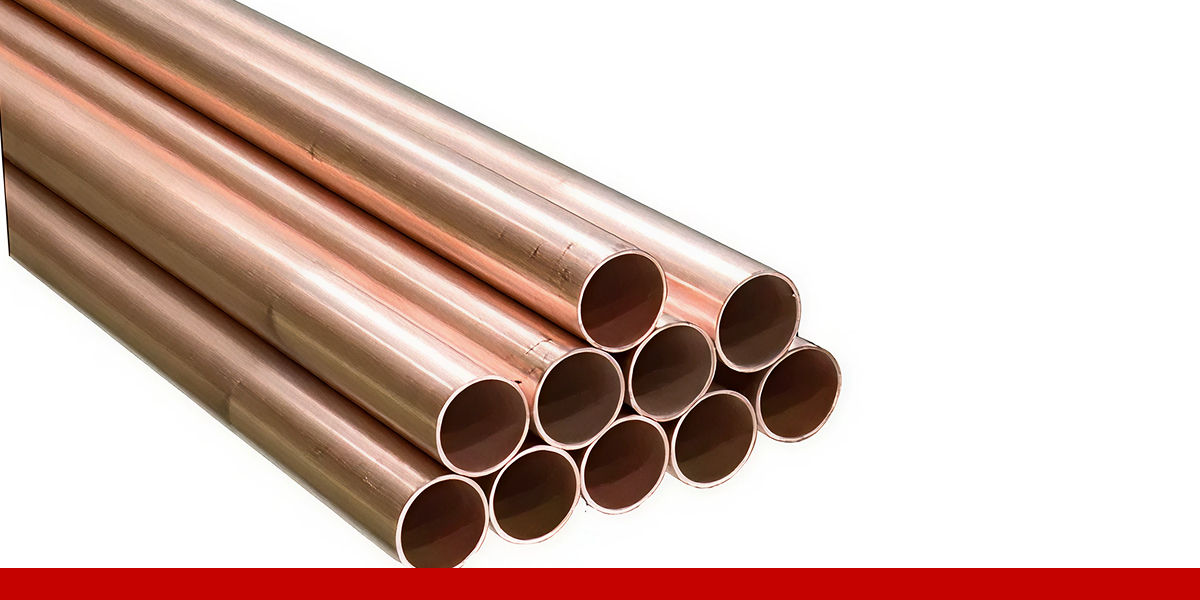
90/10 cupronickel is a copper-nickel alloy containing approximately 90% copper and 10% nickel, with small but critical additions of iron (1.0–1.8%) and manganese (0.5–1.0%). These trace elements are not incidental — iron in particular plays a decisive role in protecting the alloy against impingement attack and erosion-corrosion at high flow velocities.
The alloy is standardised under ASTM B111 (seamless tube) and ASTM B467 (welded tube), ensuring dimensional consistency and traceability for critical pressure equipment applications.
Corrosion Resistance in Seawater
Why Seawater Applications Demand Cupronickel
Ordinary carbon steel fails rapidly in seawater service. Stainless steels, while corrosion-resistant, can suffer crevice corrosion and pitting in stagnant or low-velocity seawater — particularly in tube sheet joints and under biological fouling deposits.
90/10 cupronickel forms a protective cuprous oxide film on its surface when exposed to seawater, which becomes increasingly dense and adherent over time. This natural passivation layer inhibits further corrosion while simultaneously resisting the attachment of marine organisms — a phenomenon known as biofouling resistance that reduces cleaning frequency and maintains heat transfer efficiency over long service periods.
[Insert Image Here]
Mechanical Durability
Erosion-Corrosion and Flow Velocity Resistance
One of the most demanding failure modes in heat exchanger tubing is erosion-corrosion — the accelerated material loss caused by high-velocity turbulent flow combined with corrosive seawater. 90/10 cupronickel handles flow velocities up to approximately 3.0 m/s in seawater service without meaningful erosion-corrosion damage, compared to 1.5 m/s for unprotected copper tube.
The iron additions in C70600 are the mechanism behind this resistance. Iron strengthens the protective oxide film and anchors it against shear forces from turbulent flow, preserving tube wall thickness over decades of operation.
Thermal Performance
Heat Transfer Efficiency
Thermal conductivity for 90/10 cupronickel is approximately 40 W/m·K — lower than pure copper but significantly higher than titanium or stainless steel alternatives. In properly designed heat exchanger geometries, this conductivity level delivers efficient heat transfer without requiring the tube wall thickness penalties often needed with lower-strength materials.
Industrial Applications
Key Applications
- Marine heat exchangers and seawater-cooled condensers
- Naval vessel and offshore platform cooling systems
- Desalination plant tubing and tube bundles
- Power station condenser tubing in coastal facilities
- Shipboard central cooling and auxiliary cooling circuits
Comparison with 70/30 Cupronickel
The higher-nickel 70/30 grade (C71500) offers enhanced corrosion resistance and handles higher seawater temperatures, but at significantly greater material cost. For most standard marine heat exchangers and condenser applications operating below 60°C, 90/10 delivers equivalent service life at lower overall installed cost — making it the industry standard for the majority of these systems worldwide.
Steelco Metals Supply Capability
Steelco Metals stocks 90/10 cupronickel tubing to ASTM B111 in a full range of OD and wall combinations. Request a quotation or technical datasheet from our team.
FAQs
